

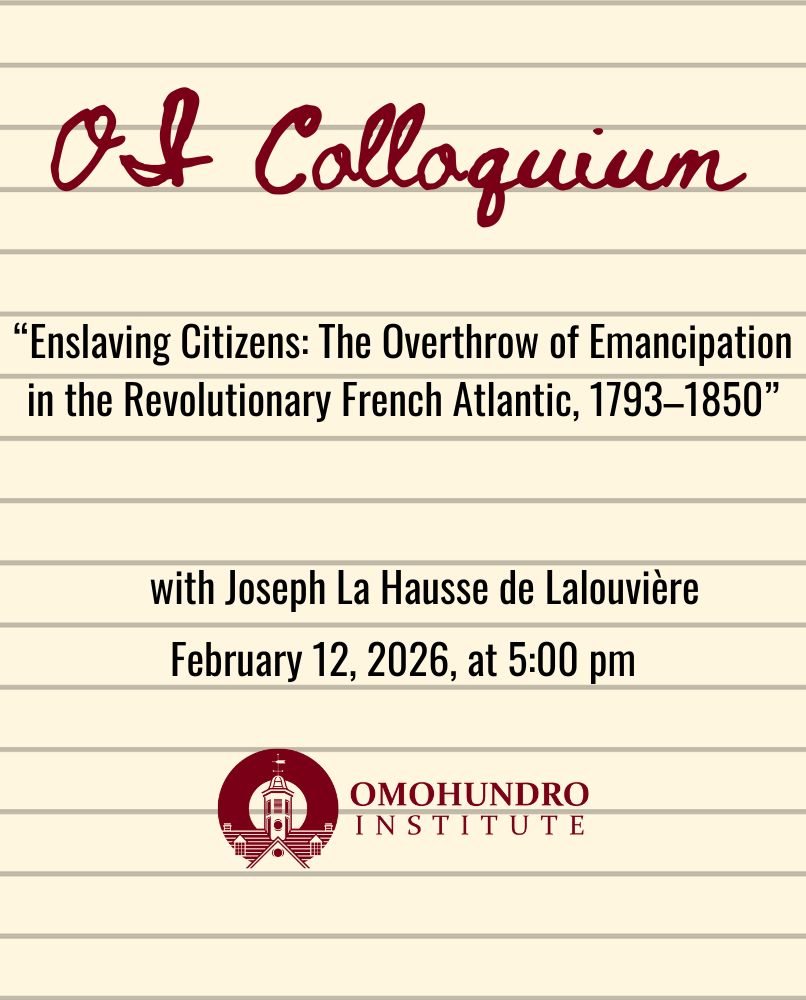
Colloq with Joseph La Hausse de Lalouvière
February 12, 2026, 5:00 pm - 6:30 pm EST
“Interpreting the Napoleonic Restoration of Slavery”
 A colloq with Joseph La Hausse de Lalouvière (University of Edinburgh)
Please note that all colloquia papers are pre-circulated. Please register via the link below to receive a copy.
The Napoleonic decision in 1802 to revoke emancipation and seek to reenslave more than 500,000 people in the Caribbean braided together two distinct traditions of colonialism—one based on slavery, the other on limited Black citizenship. These traditions arose concurrently from prudential critiques of rapacious plantation capitalism on the eve of the French Revolution. During the early Revolution, proslavery advocates and gradual abolitionists diverged as the latter attempted to end the slave trade and promote racial equality. Yet the unexpectedly radical circumstances of full abolition in 1793–1794 spooked gradual abolitionists. They pursued policies of restraining emancipation to maintain the metropolitan credibility of abolition. In doing so, however, they created a framework of limited Black citizenship that denied free colonial subjects vital protections due to citizens, leaving the door open to re-enslavement.
Joseph La Hausse de Lalouvière is a British Academy Postdoctoral Fellow at the University of Edinburgh and will start as a Lecturer (assistant professor) there in 2027. He received his PhD from Harvard University and has held postdoctoral fellowships at the Institute of Historical Research in London and Emmanuel College, Cambridge. His work explores slavery and citizenship in France and the French empire and traverses the Atlantic and Indian Ocean worlds. His first book manuscript, “Enslaving Citizens: The Overthrow of Emancipation in the Revolutionary French Atlantic,” investigates the mass re-enslavement of free people of African descent in the French Caribbean in the first half of the nineteenth century. He has also begun research for his second book project on the removal of citizenship in nineteenth-century France and the French empire. His work has appeared in Past & Present and French Historical Studies.