

Literary Mexico: From the Streets to the Archive to the Press
Literary Mexico: From the Streets to the Archive to the Press
by Javaria Abbasi
Javaria Abbasi is a predoctoral candidate at Oxford University and the recipient of a 2025 Lapidus Predoctoral Fellowship award. The fellowship provides emerging scholars $1,000 to use toward travel that helps advance their dissertation. We are grateful to Sid Lapidus for providing this opportunity. You can read more about the fellowships and past recipients via the links provided.
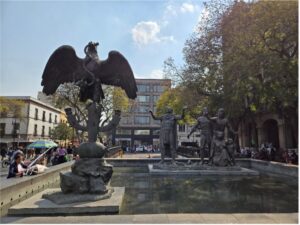 The tepid air buzzes with the hum of morning traffic and din of greeters stationed by the storefronts lining the Calle de Venustiano Carranza that runs parallel to Mexico City’s historic main square, the Zócalo. At the street corner, conspicuously positioned across from the Supreme Court, is a fountain with sculptures of five Nahua figures arranged to direct the eye towards the statue of an eagle perched atop a nopal cactus clutching a writhing serpent in its beak. This image of the eagle and cactus narrates the prophecy of the founding of the Mexica altepetl of Mexico-Tenochtitlan in 1325 as recorded in Nahua pictorial manuscripts like the Codex Mendoza (fol. 2r). Today it is the image at the centre of the Mexican flag.
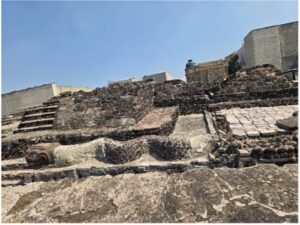
Ruins of Mexico-Tenochtitlan’s Main Temple (Huey Teocalli) in the Museo del Templo Mayor
The ethnonym “Nahua” refers to the largest cultural-linguistic group in Mesoamerica in 1519, the year that Spanish conquistador Hernán Cortés’ arrived on the Gulf coast of what is now Mexico. This cultural-linguistic group which dominated central Mexico (the modern states of Mexico, Hidalgo, Morelos, Tlaxcala, Puebla) can be grouped according to a shared language of Nahuatl, part of the Uzo-Aztecan language family like Comanche, Hopi, and Tepehuan, but was otherwise divided along tribal lines. The Nahua tribes at the time of Spanish invasion, listed in order of their own narrated settlement of the Valley of Mexico, were the Culhuaque, Cuitlahuaca, Xochimilca, Chalca, Tepaneca, Acolhuaque, and Mexica. Of these groups, the most significant to the hegemony of the region were the Mexica, Acolhuaque, and Tepaneca who headed a military coalition known as the Triple Alliance — what historians refer to as the “Aztec Empire” — that ruled from 1428 to the fall of the Mexica imperial capital of Mexico-Tenochtitlan in 1521. Even though Nahuatl was the lingua franca of Spanish colonial administration from the late sixteenth to seventeenth century, the destruction of pre-Hispanic texts in inquisitorial proceedings combined with myths of native desolation have contributed to a global historical perception of the “success” of Spanish colonization in erasing Nahua ways of knowing. Yet, in Mexico today, there are still approximately 1.5 million speakers of the Nahuatl language.
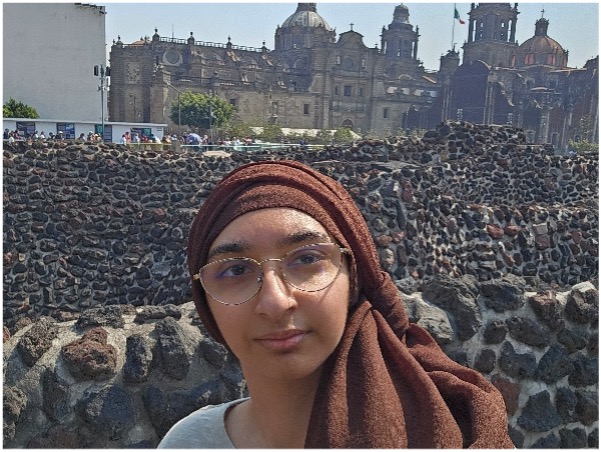
Catedral Metropolitana as seen from the ruins
Walking the streets of Mexico City, mundane allusions to the city’s pre-Hispanic past have only reinforced the framework of my dissertation.
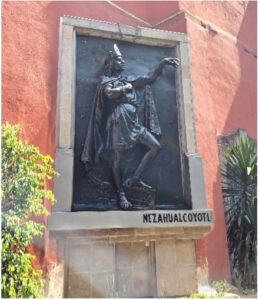
Bronze relief by Jésus Contreras of poet-king Nezahualcoyotl (1402-1472)
The central church in the Zócalo, the Catedral Metropolitana, rises from the ruins of the Mexica’s former sacred precinct excavated in the Museo de Templo Mayor. Located across from Mexico’s Museo Nacional de Arte, the Garden of the Triple Alliance on Calle Filomena Mata boasts three bronze reliefs of its acclaimed founders the Acolhua-Mexica ruler Nezahualcoyotl; Mexica emperor Itzcoatl; and Tepaneca ruler Totoquihuatzli. Four nameless Indigenous figures guard each cardinal direction at the base of a sculpture personifying Mexico as a veiled feminine supplicant with an eagle in the castle grounds of Chapultepec. The ‘disindigenization’ of Mexico was a program more successful in the designs of imperial manifestos than on the streets of its capital city or in the pages of its colonial texts.
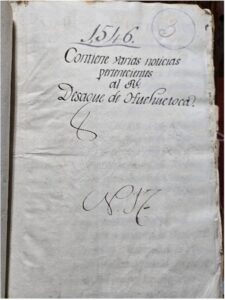
Ayuntamiento, Desague, vol. 740, exp, 4 at the Archivo Histórico de la Ciudad de México
The Archivo histórico de la Ciudad de México, Mexico City’s municipal archive collating documents from the city council’s founding in 1524, looms at the intersection of Donceles and República de Chile. The archive is hosted in a restored two-story eighteenth century building with columns and archways that frame an open-aired quadrangle. In its reading room, I found evidence further substantiating my framework of the colonial city government’s reliance on Nahua inhabitants. One such piece of evidence is a summary of events justifying the draining of central Mexico’s five historic lakes from 1546 to 1697. Entitled “Real Desagüe de Huehuetoca,” the document mentions ruinous flooding under the tenth viceroy of New Spain (1603-1607), the Marques of Montesclaros, and the colonial government’s thwarted attempt to relocate the viceregal capital to Tacubaya, failed completion of the drainage canal (desagüe) of Huehuetoca and building of an aqueduct at Chapultepec as a consolation prize. The document also attests to the vital expertise of Indigenous laborers and councilmen during reconstruction efforts spanning the sixteenth to seventeenth century. The document suggests that the Spanish colonial government’s inability to manage its waterways made them beholden to Nahua city residents. This implicates the plethora of aquatic descriptions in the two major laudes civitatum poems that are the topic of my third dissertation chapter, Bernardo de Balbuena’s Grandeza mexicana (1604) and Arias de Villalobos’ Mercurio (1623). Both poems heavily feature the viceroy in question, downplay the drowned city at the heart of their compositions, and obfuscate the continued presence of Nahua intermediaries in descriptions of civil governance. Access to the municipal archive has proven that in greater Mexico City built on the ruins of the Mexica altepetl of Mexico-Tenochtitlan, colonial realities were frequently at odds with Spanish imperial ambitions and its Nahua residents took those odds to maintain a place for themselves in the city.
A chance encounter with a bicentennial exhibit about historian Joaquín García Icazbalceta at the Museo Nacional de Antropología also proved useful to my research. Icazbalceta was one of the chief nineteenth century historians of the Franciscan Order in Mexico. 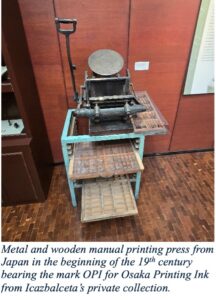 He preserved and circulated some of the very manuscripts that are the basis of my dissertation. The second chapter of my dissertation relies on his biography of the first Mexican Archbishop Fray Juan de Zumárraga as it was the first to recognize Zumárraga’s founding of the oldest printing press in the Americas (1539) which printed Nahua texts and catechisms. As a notable bibliographer, Icazbalceta ran his own printing press dedicated to the reprinting of rare early colonial Mexican books of which he held the originals. Examples of how his reprints have revitalized the study of early colonial authors can be seen in the case of Aliquot Dialogi by Francisco Cervantes de Salazar which he translated
 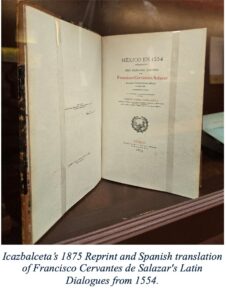 from Latin to Spanish in 1875. In 1554, this Latin textbook introduced students at the newly founded University of Mexico to the world of classical rhetoric through a walking tour of the viceregal capital of Mexico City. Icazbalceta’s version has become a staple source for articles about colonial city life. The dialogues are the primary subject of an article of mine which is currently under revision for publication. From the exhibit I learned that Icazbalceta also compiled a history of sixteenth century imprints in Mexico City and a catalogue of colonial Mexican publications in Indigenous languages. These have since become helpful sources for my dissertation. Visiting this exhibit at the Museo Nacional de Antropología structured the conclusion to my dissertation to recognize how nineteenth century historians shaped the reception of early colonial Mexican history through private ownership of printing presses that selected which works to disseminate as public history.
The Lapidus-OI Fellowship also funded my visits to Mexico City’s Museum of Print History, the Jesuit College of San Ildefonso, Franciscan College of Santa Cruz de Tlatelolco, history collection at the Castle of Chapultepec, and Diego Rivera’s private collection of Mesoamerican artefacts at the Museo Anahuacalli. Receiving the scholarship has enriched my understanding of civil governance and print history in colonial Mexico City as I finalize my dissertation.