

Vast Early America Lecture with Jonathan Gienapp
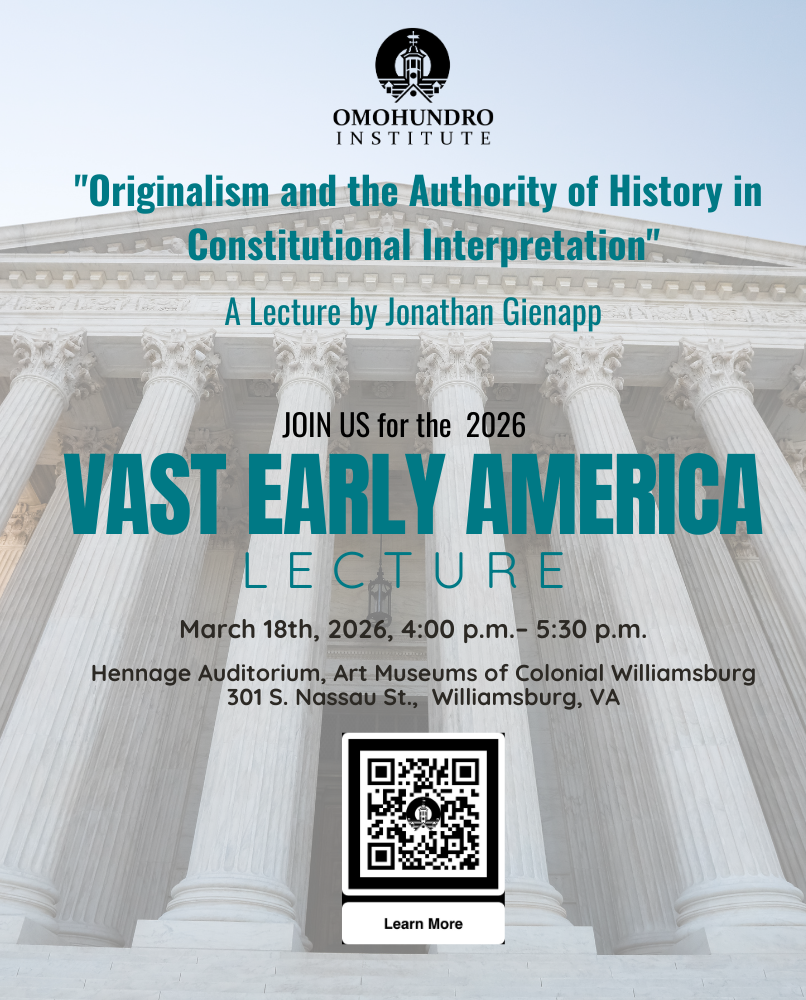
March 18, 2026, 4:00 pm - 5:30 pm EDT
“Originalism and the Authority of History in Constitutional Interpretation”
Constitutional originalism stakes law to history. The theory’s core tenet—that the U.S. Constitution should be interpreted according to its original meaning—has us decide questions of modern constitutional law by consulting the distant constitutional past, above all the late eighteenth century when the Constitution originated. Now that a majority of justices on the U.S. Supreme Court champion originalism, history is being called on more than ever to decide urgent questions of constitutional law. Yet originalist engagement with history raises as many questions as it answers. In its pursuit of modern legal answers, it often fails to appreciate the distinctive characteristics of the American constitutional past. Considering the crucial differences between constitutional thinking then and now helps us better navigate a central concern of all democracies: the authority that history should command in constitutional interpretation today.
 Jonathan Gienapp is Associate Professor of History and Law at Stanford University. His scholarship has largely focused on the history of the U.S. Constitution and its relevance to modern legal debates over its interpretation. His first book, The Second Creation: Fixing the American Constitution in the Founding Era (Harvard University Press, 2018), charted how understandings of the U.S. Constitution transformed during the decade following its ratification and won several awards. His most recent book, Against Constitutional Originalism: A Historical Critique (Yale University Press, 2024), critiques how the theory of constitutional originalism engages with the historical past and was awarded the Order of the Coif Book Award from the Association of American Law Schools. His next book will explore the forgotten history of the Preamble to the Constitution. In connection with his scholarship, he has been actively involved in deepening the public’s understanding of constitutional history including through institutions such as the National Constitution Center and the United States Marine Corp. As a member of the Historians Council on the Constitution at the Brennan Center for Justice, he helps advise legal experts on the historical dimensions of constitutional issues before the Supreme Court of the United States and has contributed to several amicus briefs to the Supreme Court.