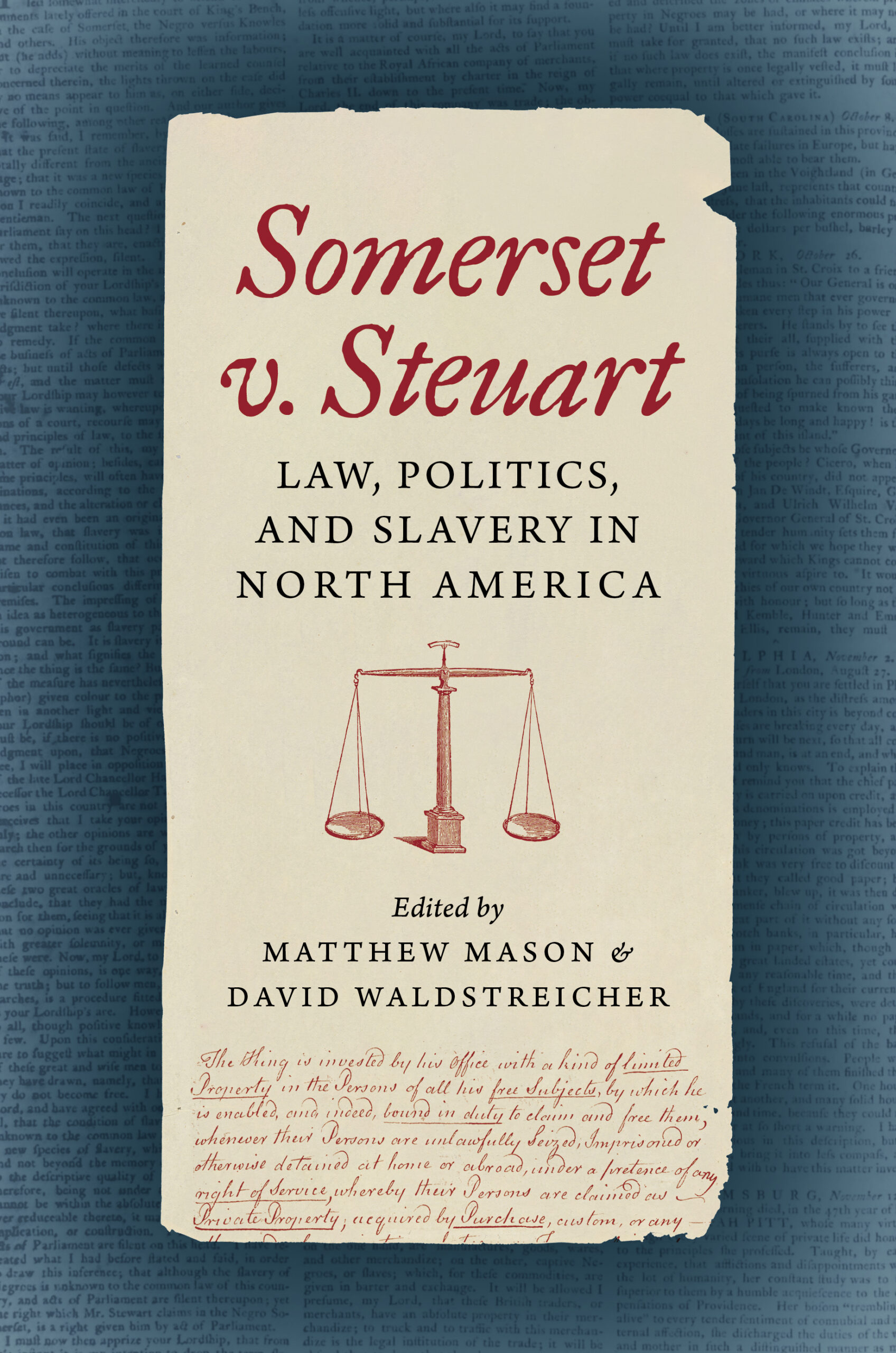
Somerset v. Steuart
Description
In the more than 250 years since Lord Mansfield pronounced judgment in Somerset v. Steuart (1772) that slavery was not supported by law in England, historians and legal scholars have probed its significance for the history of slavery and abolition in the Atlantic world. Engaging both the robust traditions of scholarship and the recent upswell of interest surrounding the case, the essays in this volume show how the ruling exposed the fissures in the seemingly solid structures of empire, slavery, and “freedom” in British North America. In the short run, the ruling amplified the alienation of white North American colonists from metropolitan Britain; in the longer run, it bolstered both proslavery and antislavery movements in the new empire of the United States.
The contributors are Harvey Amani Whitfield, John N. Blanton, Henry N. Buehner, Matthew Crow, Jesse R. Eaton, Daniel J. Hulsebosch, Matthew Mason, H. Reuben Neptune, Dana Rabin, Padraig Riley, Grant Stanton, Kirsten Sword, Evan Turiano, David Waldstreicher, Nicholas P. Wood, and Helena Yoo-Roth.
About The Author
Matthew Mason is professor of history at Brigham Young University.
David Waldstreicher is Distinguished Professor of history at the Graduate Center, City University of New York.
Reviews
“The Somerset case has attained a renewed significance to the history of the American Revolution, and the essays in this excellent volume offer a timely and enduring contribution that illuminates the context for independence. It will be a landmark volume.”—Christopher Leslie Brown, Columbia University
“Individually and collectively, these rigorously researched and lucidly written essays open new paths of inquiry that will define the contours of scholarship on the Somerset case for decades to come. This rich and rewarding volume is a triumph of sophistication, provocation, and insight into one of the most consequential and complex legal decisions in Atlantic history.”—Asheesh Kapur Siddique, author of The Archive of Empire: Knowledge, Conquest, and the Making of the Early Modern British World
“Four years before the Declaration of Independence, Lord Mansfield’s ruling in the English case of James Somerset helped turn the American Revolution into a struggle both for and against Black freedom. But what, exactly, did Somerset’s case mean in 1772? And why does it continue to matter? This splendid volume reminds us that such questions remain as important as the answers are varied.”—Eliga Gould, University of New Hampshire
Related titles
Print This Page?